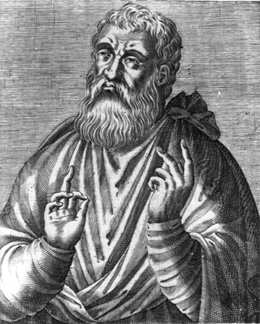
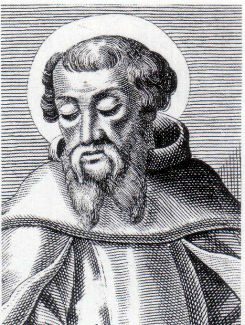
This time around, TFT goes after Clement of Alexandria. Torrance has a surprisingly balanced view of Clement (pictured), crediting him for contributing to the development of both a "scientific" approach to biblical hermeneutics (which Torrance likes) and "gnostic" approach to scripture dividing the plain historical reading from the mystical meaning, resting on an epistemological dualism between the sensible world and the intelligible word (which Torrance likes not so much).
This chapter was sizable and I don't want to spend a lot of time on it because the same themes keep coming into play. The contribution Clement makes to the history of hermeneutics that Torrance approves of are described in much the same way as Torrance's treatment of Clement's contemporary, Irenaeus. The deficiencies are comparable (and, Torrance argues, somewhat attributable) to Philo, an earlier fellow Alexandrian. Thus, I'll make some comments on the chapter, and then I'll springboard to some reflections of mine on what Torrance has done here.
First, Clement (in Torrance's description) understands faith to be "a divine power deriving from the force of the truth itself" (131). It originates in the encounter of the Word, creating in us "the new eye, the new ear, and the new heart which we need to apprehend what is given." In short, faith is neither blind nor depending on some prior knowledge; it is the establishment of an entirely new knowledge on the basis of God's revealed Truth. Clement then proceeds in terms of Aristotelian logic by employing faith as a first principle on which we can then build a scientific knowledge of God, calling into question presuppositions derived from sources other than the revealed truth known through faith. (Though faith is called into being by God's Word, it is not done so irresistibly. Torrance highlights Clement's awareness that faith "has a voluntary relation to the truth", claiming that "we are persuaded and not just compelled to believe" 133.)
What really struck me and knocked me on my donkey here is when Torrance begins to describe Clement's distinction between theology (the science that begins with faith in the way just described) and natural science and philosophy. This paragraph is worth quoting in its entirety:
The reality with which philosophy or science is concerned is passive, whereas the reality that gives rise to theology is active and dynamic. This means that in faith we have to do with a self-operating wisdom mediated to us through the Word. Faith is the strength and power of the truth , or a grace from God. Hence in interpreting the truth we have to do with a truth that interprets itself. The primary reason for this difference is that God himself is the truth of theological knowledge, God in his Word and Son revealing himself and saving us, God who is known only by his own power. (135)
There isn't much in this paragraph that I hadn't previously read in Torrance elsewhere and in Barth, but that very first sentence made something click in a new way. Let me briefly describe my former understanding of God's Word as I picked it up somewhere between church, Christian school and Bible college: after Israel got everything wrong by focusing on law, Christ came and made a way for us to be saved through by grace through faith. God has given us His Word (ie, the Bible) to tell us about this. He has also given us His Spirit to help us understand what the Word says. This understanding sees the Word as an external object which is basically passive, while the Spirit is active internally helping me to understand what I read when I pick up my Bible.
The distinction Torrance (via Clement) draws here shatters that picture. God's Word is not like a fossil that lays passively as the scientist approaches it to study it. If we take the prologue to John's gospel seriously, we must understand the Word of God in a radically personal way; "the Word became flesh". Since the Word is the risen and ever-living Lord, He is actively seeking to impart knowledge to us human beings. This is certainly done only through the historical Jesus Christ as attested by the prophets and apostles of the Old and New Testaments, but my reading of those fixed texts (though in the power of the Spirit) cannot be all we mean when we speak of approaching the Word of God; we encounter the risen Christ, the living and active Word of God in those texts. To put it another way, when I read the (passive) Bible, I encounter the (active) Word of God, (actively) pressing upon me, calling me to repent of my pride and ignorance and yield to Him, while at the same moment the Holy Spirit quickens my spirit, internally enabling me to say "Yes!" to God's Word addressed to me. Thus the Word and the Spirit work in tandem, the Word in an external objectivity and the Spirit in what Torrance has elsewhere called an "inward objectivity" (rather than subjectivity) leading people to knowledge of the Father.
This kind of trinitarian understanding of God's Word (aka Barth's understanding as furthered by Torrance) is a helpful corrective to many aspects of Evangelical theology, particularly its doctrine of Scripture. The Bible is God's Word in that it testifies to the eternal/incarnate Word of God, but we are led into trouble if we aren't careful in how we talk about scripture - the Word is a person of the triune Godhead; we cannot speak of the Bible as a person of the triune Godhead, but we can speak of it as divinely inspired servant of the eternal triune Lord and testimony to God's work of creation and redemption within human history.
 Continuing through T. F. Torrance's Divine Meaning, chapter 9 marks a significant departure from the rest of the book so far. Here, Torrance deals with a recent attack by Rudolf Bultmann upon belief in the central events that the Bible and early Christians creeds speak of, particularly the incarnation, resurrection and ascension of Christ. Bultmann called for the dymythologisation of the proclamation of early Christianity because of its commitment to a three-storied vertical cosmology. In other words, Bultmann doesn't like the New Testament's and early creeds' talk about God in spacial terms, coming down, going up, and so on. He claims that though the society in which Chist and the early church lived was bound to speak that way of God because of its primitive worldview, moder man can no longer see the universe as the early Christians did.

 Chapter 7 and 8 of Thomas F. Torrance's Divine Meaning give what amount to a small book's length introduction to Athanasius's trinitarian theology of revelation and redemption (7) and then apply this theology to theological hermeneutics (8). I want to key in on one particular issue: Torrance locating Athanasius as a biblical interpreter between a Biblicist, or one who takes the meaning of biblical statements from their immediate sense in all cases, and an allegorist, or one who sees all statements of scripture pointing to an eternal truth totally beyond their immediate sense and context.