Thursday, February 4, 2010

Don't Judge a Church By Its Website: "What We Believe" pt. 2

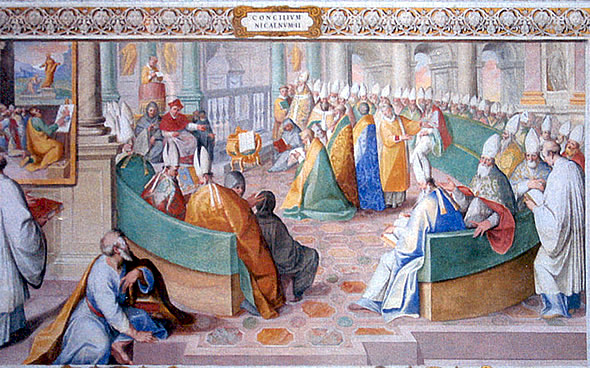
Reading Torrance's article "The Deposit of Faith" this week put a thought in my head about church doctrinal statements. Among a few other things Torrance is doing in this essay, one of them is to contrast the early ecumenical doctrinal statements, particularly the Nicene Creed, with those of the scholastic Reformed tradition, particularly the Westminster Confession. The key difference he wants to draw is that the Nicene Creed in its brevity is meant for worship - it is not primarily intended to give precise definition to the nature of God in any of his three persons or the relations between them, but to humbly and worshipfully point to the reality of the triune God in a way which both acknowledges the basic ineffability of that reality but also explicitly rules out the heresy of those such as the Arians who insist on interpreting biblical statements in mythological and anthropomorphic terms. On the other hand, the Westminster Confession and others like it with their far more cumbersome length in attempt to give precise articulation to every matter of the Reformed faith, are, in Torrance's words, "of more use to the lecture hall than the Church", being "essentially constitutional documents rather than declarations of faith before God." His point seems to be that while both share the concern to guard against heresy in these statements, Nicaea approaches this task in the form of a statement of faith meant to be used in corporate worship, carefully but humbly and transparently (in the sense of pointing to a truth it cannot fully express or contain) professing belief in the one triune God of the Bible, while Westminster seeks to exhaust the truth content of the Gospel through precise and extended formulations of doctrine which contain that truth in themselves.

Now, whether Torrance is right in this charge is certainly up for debate. What I'm interested in at this point is using this discussion as a springboard to ask: What are we doing with our church doctrinal statements? I am convinced that it is a good idea for each church to have them, and I come from a church tradition that is prone to keep them fairly short, which I think is a good idea. My sense is, though, that the only real reason we have them, or at least the only real way we use them (apart from having applicants sign them) is to give prospective visitors a way to see if we are heretics. This isn't a bad thing, but the concern I have is how much we separate this aspect (doctrine) from worship. The Apostles' and Nicene Creeds are such great examples of celebratory doctrine, or if you like, propositional worship. Given the absolutely theologically destitute state of most of our modern worship, it seems like a great idea to bring these kinds of (or perhaps precisely these) statements of faith back into the life of the church, poetically and theologically rich statements of faith that we don't merely post on our church websites or keep copies of behind the secretaries desk in the church office, but adopt or craft with the explicit intention of use in corporate worship (and of course we can throw them up on the website too). Those reading this that come from a liturgical background are probably saying "duh!", but I'm hoping those that come from backgrounds like mine which were built on a negative reaction against the bells and smells of high church liturgy will recognize our need to take greater pains in centering our worship more explicitly around the God and Gospel of Scripture. I'm not sure singing "Jesus I am so in love with you" is helpful by itself either in guarding against heresy or even in specifically drawing our minds to the Jesus of the Gospels rather than the Jesus of our psychology.

Saturday, January 23, 2010

Apostles and Inspiration

I'm working on a paper right now on the relationship between Christ and the New Testament in Torrance. For Torrance, the inspiration of the New Testament is not dealt with in terms of the Spirit's operation in and through the apostles in the particular acts of composing their distinctively inspired and authoritative documents, but in terms of the whole sweep of revelation and reconciliation accomplished in Christ as including the preparation, empowerment, and authorization of the apostles to mediate the ongoing presence of the risen Christ through power of the Holy Spirit. The preparation and empowerment included learning from Christ as disciples under a rabbi, encountering Christ in his crucified and resurrected form as the firstborn of the new creation they were given to share in, and their baptism in the Holy Spirit in which their understanding of Christ was bound to Christ's own understanding of himself. Thus for Torrance, "the apostolate, expressly formed and created by Christ...as the human end of revelation, belongs to the once for all nature of the incarnation, and is caught up in its finality and authority" (Atonement, 329-330). Torrance's concept of "onto-relations", or relations that contribute to one's identity, seems at play here; a description of the historical Jesus Christ that does not include his relationship with the apostles, his calling of them and the struggle of teaching them, the drama of their being brought into more and more intimate union with him, would be so incomplete as to be false. Christ binds them into such intimate union with them that he can tell them "whoever listens to you listens to me, and whoever rejects you rejects me." Torrance's doctrine of the inspiration of the New Testament derives from this relation between Christ and his apostles, those he sends in his name.

As I follow Torrance through this narration of inspiration, I become aware that the doctrine of Scripture I grew up with puts far less emphasis on this relation between Christ and his apostles and far more on the work of the Holy Spirit in the particular moments of inspiration. Have any of you wrestled with a similar tension? Let me pose it as a question: do you believe the New Testament books are more inspired by God than their authors were when they weren't writing those books? Do you believe that the apostle's (or other writer's of the New Testament) were given temporary infallibility when writing the New Testament documents but then lost it as soon as they stopped writing/dictating? Or are the New Testament documents the product of an ongoing ministry in which Christ was in control of his Gospel in the mouths and lives of the apostles through the ministry of the Holy Spirit? Do we worry that this latter view makes human bias and corruption too much of an obstacle for God to reveal himself through? If so, doesn't reacting with a "higher" view of Scripture (one free of the human influence of the apostles) actually mean a lower view of God's self-revealing power?

Friday, January 8, 2010

Torrance on Time and the Resurrection

Given Andy Snyder's argument that the roughly 2000 years since the resurrection makes it irrelevant by its historical distance, I thought I'd share this great paragraph from T. F. Torrance on the subject from his new book, Atonement.
The kind of time we have in this passing world is the time of an existence that crumbles away into the dust, time that runs backward into nothingness. Hence the kind of historical happening we have in this world is happening that decays and to that extent is illusory, running away into the darkness and forgetfulness of the past. As happening within this kind of time, and as event within this kind of history, the resurrection, by being what it is, resists and overcomes corruption and decay, and is therefore a new kind of historical happening which instead of tumbling down into the grave and oblivion rises out of the death of what is past into continuing being and reality. This is temporal happening that runs not backwards but forwards, and overcomes all illusion and privation or loss of being. This is fully real historical happening, so real that it remains happening and does not slip away from us, but keeps pace with us and, as we tumble down in decay and lapse into death and the dust of past history, outruns us and even comes to meet us out of the future. That is how we are to think of the risen Jesus Christ. He is not dead but alive, more real than any of us. Hence he does not need to be made real for us, because he does not decay or become fixed in the past. He lives on in the present as real live continuous happening, encountering us here and now in the present and waiting for us in the future. (Atonement, 246, emphasis his).
This is the kind of thing I am just not able to get across to the non-believer: the totally radical newness of God's act in Jesus Christ which makes all of our attempts to measure the likelihood or evidence for God's existence totally irrelevant. Jesus is risen! He is alive here and now and active among us. This cannot be deduced from other realities because it is God's new creation, transcending all old realities and recreating them according to God's redemption in Jesus. "But why? How do you know?" Why do the blind insist on staying blind?

Thursday, January 7, 2010

Torrance on World Missions

Since T. F. Torrance was the son of missionaries, I've found it strange that I rarely see him comment on the subject of missions. However, I came across this great paragraph on that subject today.
The very life process of the church is the resurgence and expansion of the new creation in Christ, right in the midst of the critical situation brought about by the cross in the world. Here that life process runs parallel to the expansion or the 'catholicising' of the person of Christ from a historical to a cosmic significance which took place at the cross where the redeeming love of God in him was at last universalised and made free to the whole world. It was the death of Christ, so to speak, that emancipated his gospel for the whole world. The cross catholicised or universalised Christ, and so it necessarily universalises or catholicises the believer at the cross and who by the cross becomes joined to Christ and therefore joined to a new universal humanity. Thus the cross introduces into the Christian outlook, the notion of universal expansion or world mission, in which all barriers of race and language are broken down, and the Christian is constrained to proclaim reconciliation to all and to live it out, for it is by that same motion of universal reconciliation that he and she have themselves been redeemed in the cross. That is why the Christian faith is necessarily missionary, because the word of the cross lodged in its heart is the word of an infinitely expanding redemption that must reach out to the uttermost bounds of the universe, embracing every tongue and tribe and people. (Atonement, 200)
Amen.

Wednesday, January 6, 2010

Grow on Walker on Torrance on Scripture (on Dancer on Prancer on Donner on Cupid)

Bobby Grow has a great quotation from Robert Walker on T. F. Torrance's doctrine of Scripture over at his Torrance blog, Behind the Back.

Monday, December 28, 2009

International Hot Tub: Round 4 part 4

(For newcomers, this is a debate between myself, a Christian, and my best friend Andy Snyder, a former Christian who is now an atheist. For a fuller introduction to the intent and explanation of the name of this series, please see the introduction. Though this is presented as a two party debate on one level, comments and responses are still fully welcomed to all posts in the comments section as a way to help extend the debate and bring other voices into it.)

I realize that by this point I've pretty much totally killed this discussion by cutting up my response to Andy's last argument into a bunch of pieces, making responding to me a laborious task. Let me here briefly respond to the last two paragraphs of Andy's last post, and then make a proposal for how to go forward.

First I'll deal with Andy's second to last paragraph:
“Of course there are other ostensibly plausible interpretations of these events. You've offered a common and compelling one, the one of the linear evolution of human understanding where we go from mythology, to religion, to naturalistic science. This story is forceful and persuasive, except for the fact that it offers no proof of itself. It is just as liable to the charge of total fabrication as is any meta-narrative of human or cosmic history.” So what do you make of the microwave background, Hubble’s constant, the fossil record (the Neanderthal, Lucy), spontaneous mutation, etc? These things certainly seem to be proof or at least evidence that the development of the universe proposed through the modern scientific worldview is valid.
I make no comment on any evidence for any theory of the development of the universe - that isn't really our topic. I'm fairly open minded and willing to listen to arguments for either young earth creationism (which I am admittedly not inclined toward for some of the reasons you've mentioned) or evolution over the course of billions of years, either through stable progression or intermittent leaps of mutation. However, the gradual evolution of the human species (which, again, I'm not married to) does not necessarily imply the evolution of world views from primitive (less true) to advanced (more true) states. Plenty of people are able to understand the universe scientifically on both the theist and atheist presuppositions, clearly debunking the idea that a scientific mind is an evolutionary step beyond the religious mind. Getting back to the issue at hand in this paragraph, your interpretation of people's claims of experiences of God along the lines of the human impulse to find patterns, and this evolving through mythology, to religion, to science, remains at rest on an untested presupposition of God's non-existence. The evidence for natural evolution offers no evidence for God's non-existence. Approaches to dealing with the question of God's existence by looking at theories of human biological evolution or psychology or sociology are all radically unscientific - they assume their conclusion, analyse totally irrelevant data according to this assumed conclusion, and then announce their victory. Its all a dodge. The validity of Christianity's claim that God reveals himself cannot be tested by appeals to any data outside of God (which is rather like testing Hubble's law by conducting Rorschach tests); God can only be known through God, and this only through repentance and faith in Christ by the power of his Spirit.

And, Andy's final paragraph:
On the final issue of worldviews being neutral, I propose there is a common underpinning in all cultural perspectives. Although it’s not neutral, it’s at the foundation of the human experience and is therefore a universal beginning point to evaluate any and all worldviews we might hold: humans are pattern-seeking. Whether it is Native Americans noticing the migration routes of the buffalo, ancient Athenian astrologers noticing the same shapes in the heavens reoccur year after year, or even a modern theologian looking for patterns in TF Torrance’s thought, our species universally takes notice of phenomena reoccurring and gives explanations for them. I propose that a worldview should be judged on how internally consistent its patterns to understand the world are. I not going to post my criticisms on the Christian perspective, but only want to offer this as a beginning point for comparative discussion of worldviews.
Indeed, humans are pattern seeking. As a Christian, however, I have to say that this pattern seeking activity is one of the many ways humanity seeks to evade God. The world views we construct are ways of keeping God at arms length, to be dealt with conceptually rather than personally. The more internally consistent my world view, the better insulated I am from God. This is the problem. There are several world views that are entirely internally consistent - how are we to measure them against each other? World views can really only be understood internally, so how are you, a proponent of scientific/naturalistic world view which values world views according to their utilitarian function of organizing data, going to evaluate the Buddhist world view? It too can only be understood internally and has its own set of values for world views (or so it appears from the outside). I fully grant that the "Christian world view", if such a thing there be, has the same problem - it insulates us from other ways of thinking and even from God. The answer must come from beyond humanity and all its pattern seeking; it must come from God, and it has. The cross of Jesus Christ is the final judgement on all insulating pattern seeking, revealing humanity's final inability to understand God through its own intellectual efforts and exposing all such efforts as fraught with ignorance and hostility toward God. To this end I do not propose any real or imagined "Christian world view" but only Jesus Christ as the total revelation of God, complete with patterns of thought that do not need to be sought, but are freely given by Christ in his teaching ministry as recorded in the Gospels. I am thus not interested in comparing world views but only in proclaiming Christ.

Now, as to how to go forward in this series, feeling that I might have killed it with the length of these last several arguments, let me propose the following options:

1) We consider these first 4 rounds (everything we've done so far) as our opening arguments and now proceed to pester each other with direct questions, one at a time. For instance, you pose a question briefly and succinctly; I answer it as briefly and succinctly as I can; you respond to my answer, commenting on whether or not I have adequately dealt with the question from your point of view; and then its my turn to ask you one.

2) We continue on as we have and you deal with everything I've said in my last four part response in whatever way you see fit and we just see if anyone keeps reading.

3) We proceed to final arguments.

I favour option 1 myself, but I'm open to any further suggestion you might have.

Tuesday, December 22, 2009

Torrance's Last Book

I'm just beginning to go through T. F. Torrance's newest and last book, Atonement: The Person and Work of Christ, which is part two of two collections of his lectures on Christology and Soteriology at New College, University of Edinburgh. This is a quote from the introduction written by the editor, Torrance's student and nephew, Robert Walker.
For Torrance, faith is what happens when through the Spirit we are brought to see personally that Christ had and has faith for us, that therefore we do not need to have a new and different faith in addition to his faith for us, and when we understand this then we realize that the faith we have is in fact the very faith of Christ himself which is now in our hearts by the Spirit. (lxxix)